TL;DR: TikTok’s algorithm is the most democratized in social media — accounts with zero followers can reach millions of views. Going viral isn’t luck; it’s engineering. This guide breaks down TikTok’s three-stage distribution system, the content hooks that stop the scroll, and how to stack the odds in your favor with every video you post.
TikTok crossed 1.8 billion monthly active users in 2025 and shows no signs of slowing. More importantly, it remains the only major platform where a brand-new account with zero followers can realistically reach millions of people with a single video. No other platform offers that kind of upward mobility.
But “going viral” isn’t random. The accounts that consistently produce high-performing content understand TikTok’s distribution mechanics at a granular level and engineer their content to trigger algorithmic promotion. This guide breaks down exactly how that works.
How Does TikTok’s Algorithm Actually Work?
TikTok’s recommendation engine — the For You Page (FYP) — is arguably the most sophisticated content distribution system in social media. Understanding its mechanics is the foundation of every growth strategy.
The Three-Stage Distribution System
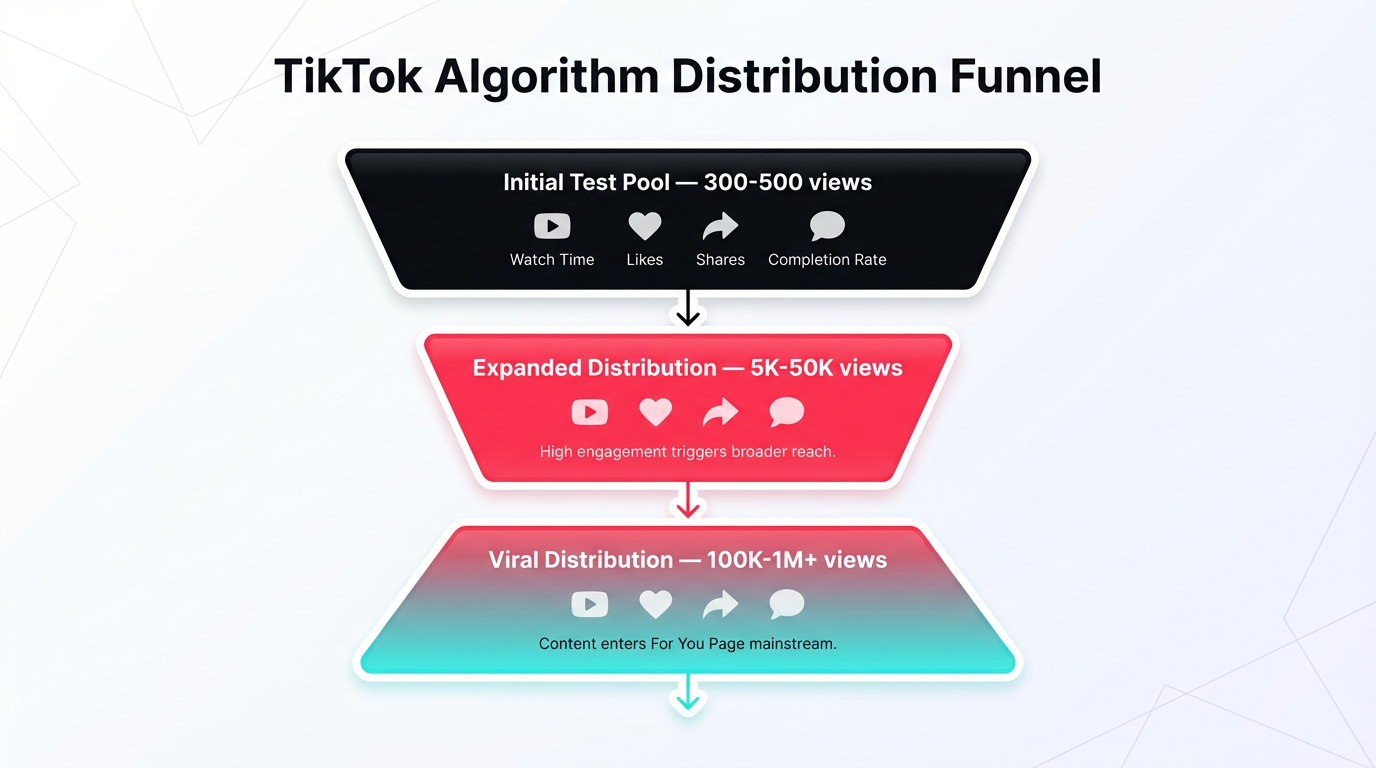
Every video uploaded to TikTok goes through a staged evaluation process:
Stage 1: Initial Test (300-500 views) Your video is shown to a small, semi-random audience — typically 300-500 users. TikTok measures how this group interacts with your content. The key metrics at this stage are:
- Completion rate — What percentage of viewers watched the entire video? This is the single most important metric. A video with 90% completion rate at Stage 1 will almost always advance to Stage 2.
- Engagement rate — Likes, comments, shares, and saves relative to views.
- Share rate — TikTok weights shares (especially shares via DM) very heavily. A video that gets shared is a video people want others to see.
Stage 2: Expanded Distribution (5,000-50,000 views) Videos that pass Stage 1 are pushed to a larger, more targeted audience. TikTok now factors in interest matching — showing the video to users whose past behavior suggests they’ll enjoy this type of content. The same metrics are evaluated, but at a larger scale.
Stage 3: Viral Distribution (100,000+ views) Videos that maintain strong metrics through Stage 2 enter broad distribution. At this point, TikTok pushes the content to audiences well beyond the creator’s typical niche. This is where videos cross the million-view threshold.
The critical insight: your video’s performance in the first 300-500 views determines everything. If you can engineer high completion rates and engagement from that initial test audience, the algorithm handles the rest.
For more on how social platforms distribute content, read our breakdown of how social media algorithms work.
What Makes a TikTok Hook That Stops the Scroll?
The first 1-2 seconds of your video decide whether someone watches or swipes. On TikTok, you’re not competing with other creators in your niche — you’re competing with every piece of content on the FYP. Your hook has to be arresting enough to interrupt someone who’s mid-scroll.
Hook Frameworks That Work
The Curiosity Gap: Open with a statement that creates a knowledge gap viewers need to close.
- “Here’s why you’ve been [doing X] wrong…”
- “Nobody talks about this, but…”
- “I tested [thing] for 30 days and the results shocked me”
The Pattern Interrupt: Start with something visually or auditorily unexpected.
- A dramatic zoom on an unusual object
- A loud sound effect followed by silence
- An unexpected scene (you talking from an unusual location)
The Direct Address: Speak directly to a specific audience.
- “If you’re a small business owner, watch this”
- “POV: You just discovered [niche insight]”
- “This is for everyone who’s been struggling with [problem]”
The Bold Claim: Make a confident assertion that invites either agreement or debate.
- “[Common belief] is completely wrong. Here’s why.”
- “This one change doubled my [metric]”
- “Stop doing [thing] immediately — here’s what to do instead”
The data backs this up: videos with strong opening hooks see 60-80% higher completion rates compared to videos with slow intros. Those completion rates directly translate to algorithmic distribution.
What’s the Ideal TikTok Video Length?
Video length is one of the most debated topics in TikTok strategy. Here’s what the data shows:
7-15 seconds: Highest completion rates. Best for simple tips, reactions, and trend participation. Ideal for new accounts trying to build initial momentum because short videos are easier to get watched fully.
30-60 seconds: The sweet spot for educational content, tutorials, and storytelling. Long enough to deliver real value, short enough to maintain strong completion rates. Most viral educational content falls in this range.
60-180 seconds: Suitable for in-depth tutorials, storytelling, and explanatory content. TikTok actively promotes longer content to compete with YouTube, but completion rates naturally drop. Only use this length when the content genuinely requires it.
The rule: Make the video as short as possible while delivering complete value. If you can make your point in 15 seconds, don’t stretch it to 60. Every unnecessary second reduces your completion rate, and completion rate is the metric that matters most.
How Do Trending Sounds Drive Growth?
TikTok’s algorithm gives a measurable boost to videos using trending sounds. When a sound is gaining popularity, TikTok actively distributes videos using that sound to a wider audience — riding a trending sound can increase your video’s initial reach by 30-50%.
How to Find and Use Trending Sounds
- Check the Creative Center. TikTok’s Creative Center (available at tiktok.com/business/creative-center) shows trending sounds by region and industry. Filter for sounds that are growing but haven’t peaked yet — these offer the most opportunity.
- Browse your FYP intentionally. When you hear the same sound 3+ times during a scrolling session, it’s trending. Save it immediately.
- Use the sound search feature. Tap the sound on any video, and TikTok shows you how many videos have been created with it and whether usage is trending up or down.
- Move fast. Trending sounds have a lifecycle of roughly 3-7 days. The creators who capitalize on a sound in its first 48 hours get the most distribution.
Important: don’t force trending sounds onto content where they don’t fit. The algorithm evaluates engagement quality, and viewers can tell when a sound is irrelevant to the content. Use trending sounds when they naturally complement your message.
How Often Should I Post on TikTok?
Posting frequency is TikTok’s volume game. Unlike Instagram, where posting too often can hurt you, TikTok rewards high output. The more content you post, the more chances you have of hitting a viral video.
Minimum for growth: 1 video per day, 7 days per week.
Optimal for aggressive growth: 2-3 videos per day.
Maximum useful frequency: 4-5 videos per day (beyond this, quality typically suffers and each video cannibalizes the others’ engagement).
Here’s why volume matters: even experienced creators have a “hit rate” of roughly 10-20%. That means for every 10 videos, 1-2 will significantly outperform the rest. If you post once per day, you’ll get 3-6 strong performers per month. If you post 3 times per day, you’ll get 9-18 — and any one of those could be the video that goes viral and pulls tens of thousands of new followers.
The strategy isn’t to make every video perfect. It’s to make every video good enough to pass Stage 1 testing, and to post enough volume that probability works in your favor.
How Does Initial Engagement Trigger the Viral Loop?
This is where most growth guides stop, but it’s arguably the most important concept on TikTok: the viral loop is a positive feedback cycle, and the hardest part is getting it started.
Here’s the loop:
- Your video gets shown to 300-500 people (Stage 1)
- If engagement is strong, it gets pushed to 5,000-50,000 (Stage 2)
- Strong engagement at Stage 2 triggers 100,000+ distribution (Stage 3)
- Viral reach drives profile visits and follows
- New followers engage with your next video, giving it a stronger Stage 1 performance
- Repeat
The bottleneck is Stage 1. If your video doesn’t perform well in front of those initial 300-500 viewers, the loop never starts. This is why smart creators use every available tool to maximize their Stage 1 metrics.
Tactics for maximizing Stage 1 performance:
- Engage with your niche before posting. Spend 15-20 minutes liking and commenting on content in your niche. This primes TikTok’s algorithm to show your next video to people who engage with similar content.
- Post at peak hours. While TikTok is less time-sensitive than other platforms, posting when your target audience is active increases the quality of your Stage 1 audience.
- Respond to every comment within the first hour. Comments generate more comments. Each response is counted as a new comment, doubling your engagement metrics.
- Use an SMM panel strategically. Boosting engagement on your most promising videos during the critical Stage 1 window can push them past the threshold into wider distribution. SMP’s TikTok services provide the initial engagement spike that triggers the viral loop.
What Are the Best TikTok Content Formats in 2026?
Certain content formats consistently outperform on TikTok:
Educational/How-To Content: “How to [achieve result] in [timeframe]” is one of the most searchable and shareable formats on TikTok. These videos serve a functional purpose, making viewers more likely to save and share them.
Story-Based Content: Narratives with a beginning, conflict, and resolution keep viewers watching until the end. “Storytime” videos have some of the highest completion rates on the platform.
Duets and Stitches: Reacting to or building on another creator’s content piggybacks on their audience. Duet trending videos with your unique perspective to tap into their distribution.
POV Videos: “POV: You just [scenario]” videos create immersive, relatable content that drives comments and shares.
Transformation/Before-After: Visual transformations (design, cooking, fitness, organization) are inherently satisfying to watch, driving high completion and save rates.
Controversial Takes: Respectful contrarian opinions generate discussion. Videos with high comment-to-view ratios get algorithmic boosts because TikTok interprets comments as deep engagement.
What Mistakes Kill TikTok Growth?
- Deleting videos that “underperform.” TikTok can resurface old videos days or weeks after posting. Deleting them removes that possibility. Leave everything up.
- Using watermarked content. Cross-posting from Instagram Reels with visible watermarks gets suppressed. Always upload native content.
- Ignoring your analytics. TikTok’s analytics show exactly which videos performed and why. Study your completion rate curves — the point where viewers drop off reveals exactly where your content fails.
- Chasing trends without adding value. Doing a trending dance or using a trending sound without adding your own spin is forgettable. The accounts that grow put their unique perspective on trends.
- Posting and ghosting. Not engaging with comments in the first hour leaves engagement on the table. The first hour is your highest-leverage window.
- Overthinking production quality. TikTok’s audience values authenticity over polish. A well-lit, well-hooked iPhone video outperforms a heavily produced, slow-starting studio video every time.
How SMP Can Help
TikTok’s algorithm rewards momentum. The challenge is generating that initial engagement that triggers Stage 2 and Stage 3 distribution. SMP provides targeted TikTok growth services that help you:
- Boost views on promising videos to push them past the Stage 1 threshold and into wider distribution.
- Increase follower counts to build the social proof that converts profile visitors into followers.
- Amplify likes and engagement on your best content during the critical first-hour window.
- Kickstart new accounts that haven’t yet built an organic audience.
With SMP’s TikTok services, you get fast delivery, competitive pricing, and services designed to complement — not replace — your organic content strategy. The goal is to give your best content the initial push it needs to reach the audience it deserves.
Key Takeaways
- TikTok’s three-stage distribution system evaluates your video in front of 300-500 viewers first. Everything depends on how that test audience responds.
- Completion rate is the #1 metric. Engineer your content to be watched until the end — strong hooks, tight editing, no filler.
- Post 1-3 times daily. Volume creates opportunities. Even great creators only “hit” on 10-20% of their videos.
- Hook viewers in the first 1-2 seconds. Curiosity gaps, pattern interrupts, and bold claims work best.
- Keep videos as short as possible while delivering complete value. 7-60 seconds is the sweet spot for most content.
- Use trending sounds within 48 hours of them gaining traction for an algorithmic boost.
- Engage with comments in the first hour to double your engagement metrics and signal quality to the algorithm.
- Use tools like SMP to boost initial engagement on your most promising videos and trigger the viral distribution loop.
- Never delete underperforming videos — TikTok can resurface them days or weeks later.